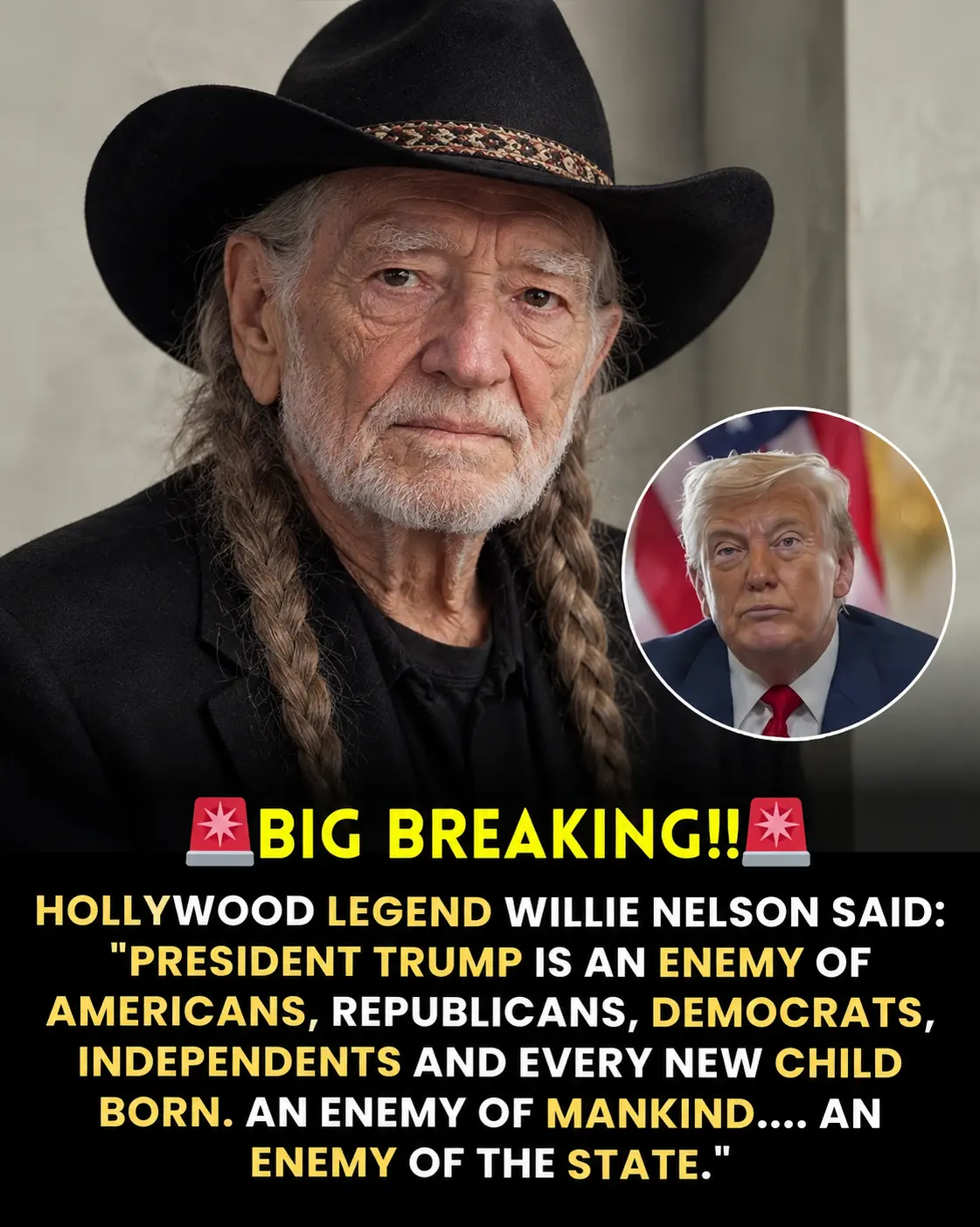
🚨 BIG BREAKING: WILLIE NELSON AND DONALD TRUMP — THE VIRAL QUOTE THAT SET SOCIAL MEDIA ABLAZE
A highly charged political story involving legendary musician Willie Nelson and President Donald Trump has exploded across social media, drawing intense reactions from people on both sides of America's political divide.
The headline is dramatic.
The alleged statement is even more dramatic.
And within hours, the claim began appearing across social-media pages, political discussion groups, and viral-content websites, with users debating what Nelson supposedly said about Trump, his leadership, and the direction of the country.
But there is an important distinction that deserves attention before the story goes any further:
The specific quote currently circulating online has not been independently verified.
That means the alleged statement should not be presented as a confirmed quotation from Willie Nelson.
Still, the controversy surrounding the claim reveals something larger about modern political culture — and why statements attributed to famous musicians can spread with extraordinary speed.
A SINGLE QUOTE BECOMES A NATIONAL DEBATE
According to the viral version of the story, Willie Nelson supposedly made an extremely critical comment about Donald Trump.
The wording circulating online is intentionally provocative, designed to create an immediate emotional reaction.
Supporters of Trump reacted angrily.
Critics of Trump shared the claim approvingly.
Others questioned whether Nelson had actually said the words at all.
Within the online conversation, the distinction between those three reactions quickly became blurred.
Some posts presented the statement as breaking news.
Others described it as a historic moment.
And some users simply repeated the quote without identifying where or when Nelson supposedly made it.
That is precisely where viral political stories can become difficult to evaluate.
A statement can be repeated thousands of times while still lacking a reliable primary source.
WILLIE NELSON HAS A LONG POLITICAL HISTORY
The controversy is especially believable to some readers because Willie Nelson has never been completely detached from American political life.
Throughout his career, the country music icon has spoken publicly about political and social issues.
In a 2017 interview with The Washington Post, Nelson discussed political divisions in America and criticized then-Attorney General Jeff Sessions over marijuana policy.
He has also supported political candidates in different periods of his career.
In 2018, The Guardian reported on Nelson's political involvement and described him as identifying himself as a politically independent person. The newspaper also noted his support for several Democratic figures and his opposition to aspects of the Trump administration's agenda.
So while the latest viral quote remains unverified, Nelson is not a celebrity with no history of discussing politics.
That context matters.
It explains why audiences may find a politically charged statement attributed to him believable.
But plausibility is not proof.
NELSON HAS ALSO DESCRIBED HIMSELF AS SOMEONE WHO AVOIDS POLITICAL DIVISION
Interestingly, Nelson has previously offered a more complicated description of his relationship with politics.
In an interview about his book Willie Nelson's Letters to America, he said he had generally tried to stay away from partisan politics because his audience includes people with different political beliefs.
He explained that Republicans, Democrats and independents could all attend his concerts, and he did not want politics to become the defining feature of his relationship with his audience.
That makes the latest viral claim particularly interesting.
It creates a tension between the image of Nelson as a politically engaged public figure and the musician's own comments about avoiding unnecessary political division.
That tension is one reason readers should look for the original interview, video, transcript, or full quotation before accepting a dramatic statement as authentic.
WHY THE CLAIM SPREAD SO QUICKLY
The internet rewards emotional content.
A calm discussion about public policy may receive limited attention.
A shocking celebrity quotation about a sitting president is different.
It immediately creates opposing reactions.
People share it because they agree.
People share it because they are angry.
People share it because they want to challenge it.
And people sometimes share it simply because they want to know whether it is true.
Every reaction increases visibility.
That can create a powerful feedback loop in which a claim appears increasingly credible simply because more people are discussing it.
But popularity and verification are not the same thing.
A PATTERN OF FAKE CELEBRITY QUOTES
There is another reason for caution.
Fact-checkers have documented multiple examples in 2026 of fabricated political statements being attributed to Willie Nelson and other celebrities.
In January, Lead Stories investigated a viral claim that Willie Nelson and numerous other entertainers had called Trump a “vicious old bastard draining America's soul.” The organization reported that the quote was fabricated and that nearly identical versions had been attributed to a long list of celebrities.
Another Lead Stories investigation found a separate viral claim falsely suggesting Willie Nelson and dozens of other celebrities had defended Trump using identical language.
Those findings do not prove that every statement attributed to Nelson is false.
But they do establish an important pattern:
Willie Nelson's name has previously been used in fabricated political content.
That makes verification especially important when a new sensational quotation appears online.
THE POLITICAL DIVIDE BEHIND THE STORY
Regardless of whether the latest quote is authentic, the reaction to it reflects the enormous political divide surrounding Donald Trump.
Trump remains one of the most polarizing figures in American political life.
His supporters view his political movement through one set of priorities.
His critics view his record and rhetoric through another.
That disagreement has become part of everyday political conversation, from television networks to social media feeds.
Celebrity voices can intensify that conversation because they reach audiences far beyond traditional political institutions.
When a musician with decades of cultural influence is supposedly criticizing a president, the story can quickly become larger than the original statement.
It becomes a debate about celebrity influence, political speech, free expression, and the role entertainers should play in public life.
WHY SOURCE MATTERS MORE THAN THE HEADLINE
The most important question surrounding the viral story is surprisingly simple:
Where is the original recording?
Was there an interview?
Was there a transcript?
Was the quote published by a reputable news organization?
Was the statement made during a concert, television appearance, podcast, or press conference?
Without those details, readers are being asked to trust the headline rather than the evidence.
That is particularly dangerous with political content.
A fake celebrity quotation can easily influence how people perceive both the celebrity and the politician being discussed.
And once thousands of people have repeated a statement, correcting it becomes much harder.
THE STORY IS BIGGER THAN ONE QUOTE
The Willie Nelson controversy therefore raises a broader question about the modern information environment.
How quickly should people believe something simply because it confirms what they already think?
That question applies to everyone.
Trump supporters can encounter fabricated statements attacking Trump.
Trump critics can encounter fabricated statements supposedly supporting him.
The same celebrity can even be placed on opposite sides of an argument depending on which viral page is publishing the story.
That is why the original source matters.
Not the number of shares.
Not the number of comments.
Not the emotional intensity of the headline.
The evidence.
WHAT WE CAN ACTUALLY SAY
There is a documented history of Willie Nelson discussing politics and expressing views on public issues.
There is also documented evidence that fabricated quotations have previously been attributed to him in viral political content.
The specific highly critical statement now circulating about Donald Trump, however, should be treated as unverified unless a reliable primary source emerges.
That distinction does not tell readers what political conclusion to reach.
It simply separates documented information from an online claim.
And in an era when a single sentence can reach millions of people before anyone checks its origin, that distinction matters more than ever.
THE VIRAL MOMENT THAT MAY NOT BE WHAT IT SEEMS
Willie Nelson's name carries enormous cultural weight.
Donald Trump's name carries enormous political weight.
Put the two together in a dramatic headline, and the result is almost guaranteed to attract attention.
But attention is not authentication.
The viral quote may continue circulating.
People will continue debating it.
Some will celebrate it.
Others will condemn it.
Still others will question whether Nelson ever said it.
For now, the responsible conclusion is straightforward: the specific quote remains unverified, while Nelson's broader history of political engagement is well documented.
The story is therefore not simply about what Willie Nelson supposedly said.
It is also about how quickly modern audiences can turn an unverified sentence into a political event.
And perhaps that is the most important lesson hidden inside the controversy:
Before reacting to the quote, find the source.
Before sharing the headline, check the evidence.
And before turning a viral claim into history, make sure it actually happened.