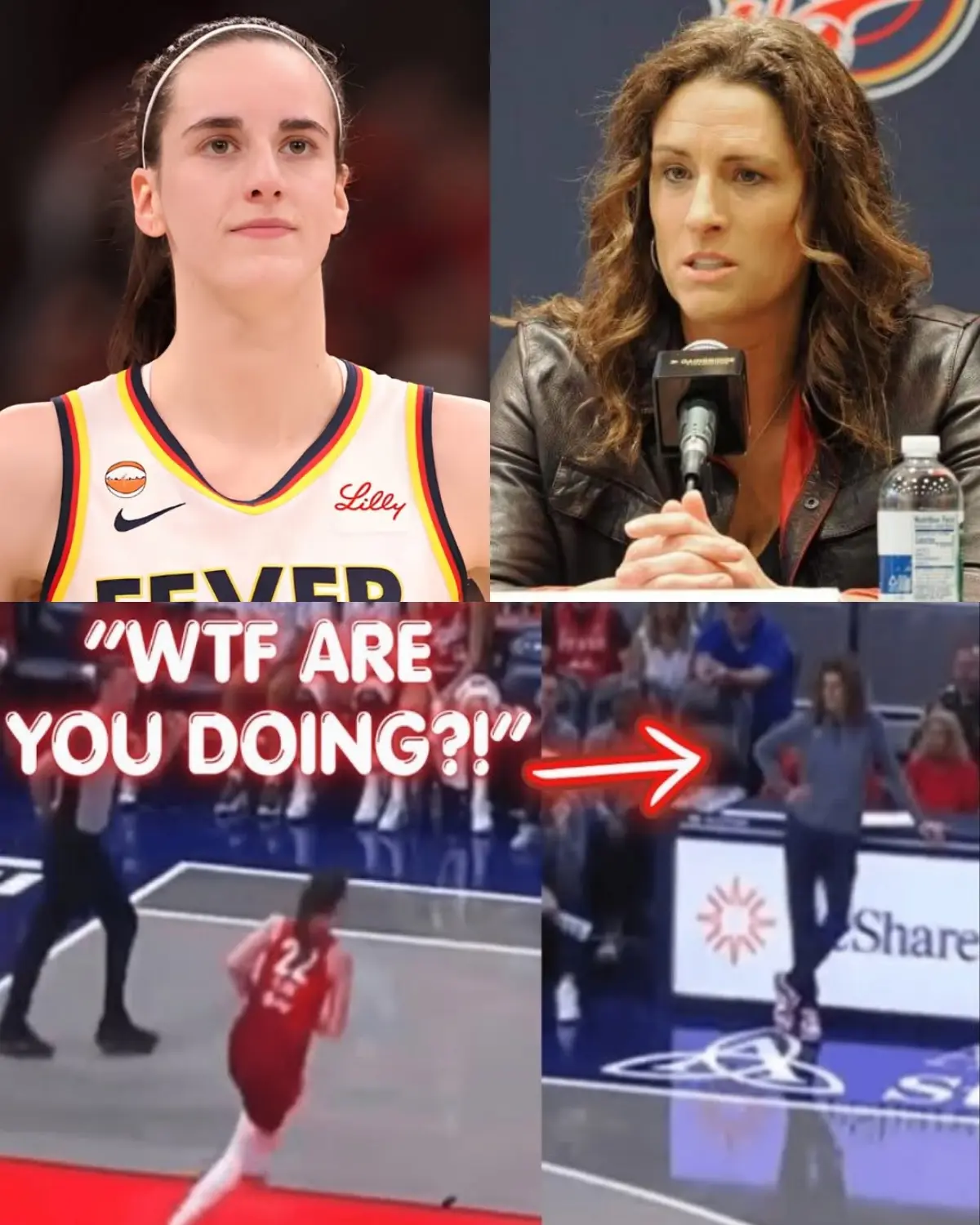
The deafening, metallic crash of an overturned metal chair violently kicked across the varnished baseline apron echoed through Gainbridge Fieldhouse like a blast, immediately driving courtside parabolic boom microphones into screaming digital red-line distortion across nationwide live prime-time broadcasts.
Nobody moved. Nobody could speak.

In the middle of a high-pressure fourth-quarter timeout, with eighteen thousand screaming fans watching in disbelief as the Indiana Fever’s offensive sets collapsed under relentless opposing pressure, the illusion of franchise unity shattered into pieces.
Standing dead center in the team huddle, drenched in sweat, veins bulging along her neck and eyes blazing with pure unvarnished fury, Caitlin Clark snapped. Towering over head coach Stephanie White with her chest heaving, Clark pointed a white-knuckled, trembling finger straight between White’s eyes.
Before eighteen thousand stunned spectators and an international television audience numbering in the millions, Clark unleashed an earth-shattering, nineteen-word verbal execution that instantly paralyzed the entire arena: “Sydney Johnson outcoached you in every matchup, proving your Vanderbilt playbook is completely worthless against championship contenders!”
The entire home bench collapsed into immediate, suffocating bedlam.
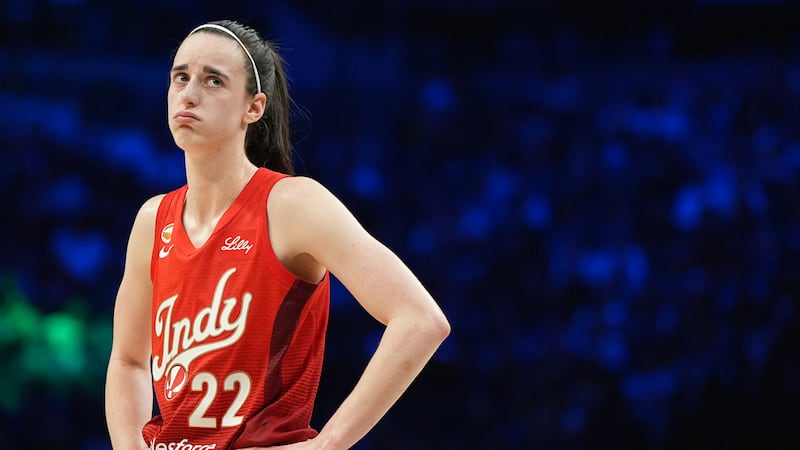
Stephanie White stood completely frozen on the hardwood. Her jaw hung slack, her eyes went wide behind her glasses, and her face drained of every drop of color as the words hung in the humid arena air like a death sentence.
She was entirely immobilized.
Beside the coaching huddle, assistant coaches stared in sheer horror, completely petrified to speak, while players sat pinned to their chairs in dead silence, looking down at the floor as thousands of fans in the lower bowl rose to their feet in disbelief. Across the baseline, arena security supervisors and franchise executive liaisons scrambled toward the boundary line, whispering frantically into their lapel microphones as network television directors scrambled to keep their close-up 4K cameras fixed on the volcanic standoff.
Then it happened.
Refusing to listen to a single word of tactical explanation, Clark grabbed her hydration towel, whipped it onto the floor at White’s feet with icy disdain, and walked toward the far end of the baseline apron. Pacing back and forth like a caged predator while broadcast cameras captured every split-second movement in crystalline clarity, Clark muttered in disgust as a deafening chorus of boos began raining down from the upper tiers directly onto the home coaching staff.
The humiliation was absolute, public, and broadcast across five continents.
To millions of stunned viewers watching at home, this was not merely a hot-headed superstar venting frustration during a difficult stretch. It looked like the definitive, public execution of a coaching regime that fans believe had been systematically exposed as outdated, stubborn, and completely incapable of competing against elite basketball minds.
The suspicion of tactical bankruptcy and deliberate suppression had been quietly smoldering long before this shocking sideline blowout.
For months, basketball analysts and sharp-eyed tape breakdown specialists had tracked an undeniable, deeply perplexing pattern that seemed to defy the basic laws of competitive athletics. Observers pointed to the eerie similarities between Indiana’s late-game offensive paralysis and the contentious international tournament rotations in Berlin during the World Cup run.
Back then, on the global stage under national team head coach Kara Lawson, fans watched in total disbelief as Clark was systematically throttled on the bench while established veterans struggled through historically stagnant offensive stretches. In contests where the American half-court sets ground to an agonizing halt—most notably during a grueling, unwatchable 55–52 survival against an underdog Italian squad—the ball was stubbornly kept away from the most explosive playmaker on the planet.
The game film from that afternoon in Europe told a harrowing story of intentional isolation.
Possession after possession, Clark would sprint down the hardwood in transition, flashing into acres of wide-open space along the perimeter with her hands raised, completely unguarded. Yet veteran ball-handlers repeatedly pulled down defensive rebounds, glanced up the floor, saw Clark waving in rhythm thirty feet from the cup, and deliberately turned their backs on the outlet pass. Independent breakdowns tore across digital platforms, exposing how the game’s premier perimeter weapon was rendered an offensive ghost, logging eighteen baffling minutes and finishing that contest without a single made field goal.
And then everything changed.
Whenever Clark was finally inserted into the lineup alongside the second unit, the court geometry transformed instantaneously. Opposing defenses panicked thirty feet from the basket, passing lanes opened up like floodgates, and younger players scored at will. In subsequent blowouts against Czechia and Hungary, Clark came off the bench and put on an absolute playmaking masterclass, dishing out nine assists with an eye-popping +36 plus-minus that shattered long-standing tournament records.
Yet, the moment the final buzzer sounded, the starting lineup remained rigidly frozen. Outraged supporters inundated official federation channels with hundreds of thousands of demanding comments, alleging blatant seniority favoritism and accusing the coaching hierarchy of burying Clark to protect the fragile legacy of established veterans.
When Clark returned to domestic play in Indianapolis, millions of fans believed the systemic suppression was finally over.
They believed a franchise that had languished at the bottom of the league standings for years would build an impenetrable fortress around its generational prodigy, pairing her with All-Star center Aliyah Boston and scoring guard Kelsey Mitchell to create an unstoppable dynasty.
Instead, the rot had only burrowed deeper into the team structure.
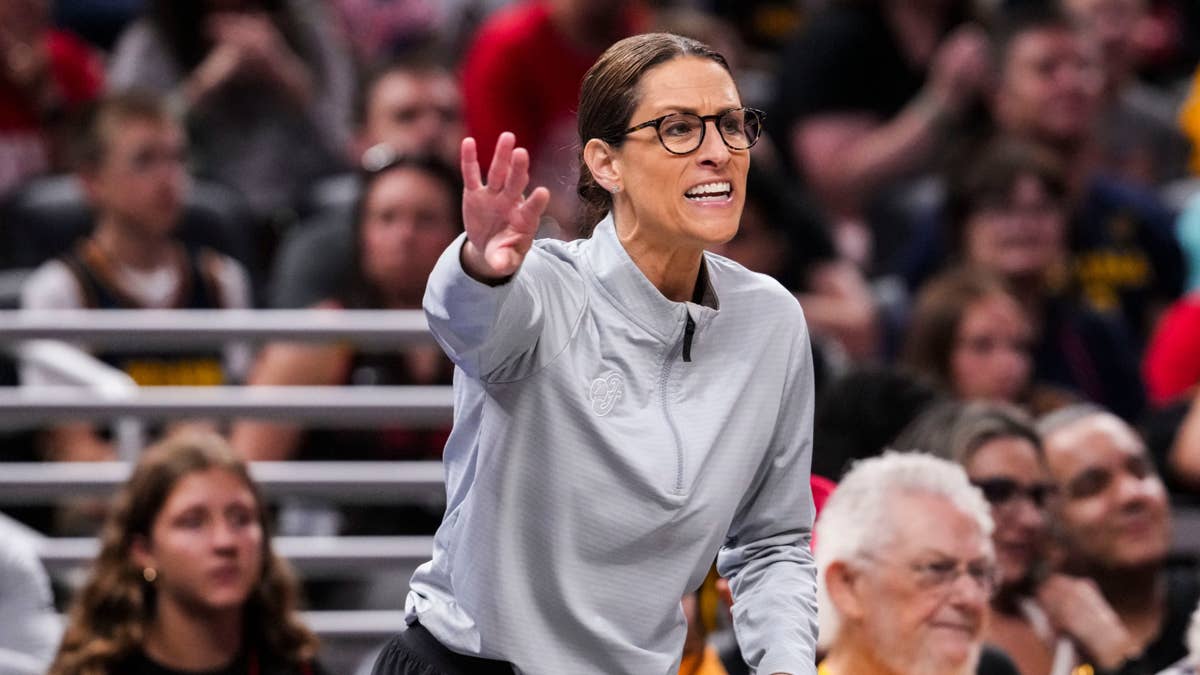
Throughout the regular season, tactical rotation patterns under Stephanie White began looking increasingly erratic, bordering on mathematically inexplicable. Whenever Clark and Mitchell caught fire together in the backcourt—pushing the tempo, knocking down transition three-pointers, and building double-digit advantages—a timeout would abruptly be called.
Without warning or tactical justification, White would pull Clark to the pine or force the offense into suffocating half-court sets that completely eliminated transition lanes.
Sports talk radio switchboards across the country began lighting up with bewildered callers. Independent analysts on digital roundtables openly questioned why a coaching staff would intentionally throttle the usage rate of the most prolific offensive engine in modern sports history. Advanced tracking metrics revealed an alarming anomaly: against upper-echelon playoff contenders, Indiana’s offensive efficiency plummeted into the lowest percentiles whenever White mandated slow, methodical half-court sets that neutralized Clark’s transition speed.
Fans began whispering about an unspoken agenda behind the scenes.
Rumors circulated that coaching personnel were deeply rattled by Clark’s unilateral basketball gravity, terrified that her soaring fame and rapid-fire tempo were completely exposing the staff’s inability to design modern, championship-level schemes. Against the league’s top-tier franchises, White’s playbook looked like a relic of a bygone era: predictable, slow-paced, and easily dismantled by opposing tacticians who crowded passing lanes and dared Indiana to adapt.
Then came the tactical disaster that detonated the entire building.
Facing an elite opponent whose schemes were being masterminded with precision by tactician Sydney Johnson, the glaring deficiencies in White’s rigid coaching philosophy were torn wide open under the national spotlight. From the opening tip, Johnson’s defensive traps systematically crowded the passing lanes, daring Indiana to adjust its predictable half-court sets.
Yet, throughout the entire contest, White stubbornly refused to adjust.
While Clark fought through relentless double-teams, hit logo-distance three-pointers, and pleaded for high-screen actions to unlock perimeter spacing, the coaching staff repeatedly insisted on running slow, low-block sets that collapsed straight into Johnson’s waiting interior defenders. On the defensive end, White’s refusal to adjust coverage allowed the opposition’s perimeter shooters to light up the scoreboard with wide-open, back-breaking three-pointers.
Sydney Johnson’s sideline adjustments were lethal, anticipating every telegraphed pass and baiting Indiana into unforced errors.
By the fourth quarter, the Fever were suffocating under their own schemes.
Clark had repeatedly bypassed the set plays to generate scoring sparks on pure instinct, pulling up from the logo and threading pinpoint passes through needle-thin gaps. But every time momentum shifted, White’s frantic sideline play-calls dragged the team back into the mud. When White called that fateful timeout only to diagram the exact same stagnant, slow-motion action on her clipboard, Clark’s patience ran out permanently.
The chair was kicked. The nineteen-word strike was screamed into the microphones. And Coach White was frozen where she stood.
“Sydney Johnson outcoached you in every matchup, proving your Vanderbilt playbook is completely worthless against championship contenders!”
The words exploded across social media feeds with terrifying speed, racking up tens of millions of views across global networks before the final buzzer had even sounded.
But that wasn’t the worst part.
As the final horn echoed through the arena confirming another agonizing defeat against a top-tier opponent, arena operations descended into an administrative panic.
Rather than conducting standard post-game procedures, security details rushed both teams off the hardwood, escorting the coaching staff through a reinforced side breezeway as thousands of furious fans hurled debris and program booklets toward the home tunnel.
Then, barely forty-five minutes after the final buzzer, an emergency document leaked directly from league headquarters, sending shockwaves through the entire sporting landscape.
Obtained by investigative sports reporters and broadcast across digital networks, the leaked administrative memorandum was marked with highest-priority executive tags: “EMERGENCY DISCIPLINARY INQUIRY: GAINBRIDGE SIDELINE ALTERCATION & BENCH INTEGRITY.”
The document revealed that the league front office had launched an immediate, extraordinary investigation into the fourth-quarter incident, reviewing 4K broadcast angles and courtside microphone feeds to determine whether Clark’s confrontation and insubordination against coaching staff constituted a punishable conduct infraction.
Even more explosive, the memo noted that the league’s competition committee was simultaneously reviewing internal complaints regarding “verbal abuse of staff and unauthorized sideline disruptions,” raising the terrifying possibility of an emergency multi-game suspension for the sport’s biggest star.
The digital sports world detonated into pure fury.
“If the league dares to suspend Caitlin Clark for speaking the absolute truth on that sideline, they will face a catastrophic worldwide boycott!” one prominent sports analyst shouted during an emergency midnight broadcast panel. “Clark stated a cold, undeniable basketball fact: Sydney Johnson completely out-coached Stephanie White! The Vanderbilt system cannot compete against modern, elite championship teams. She has carried this franchise’s television ratings, ticket sales, and global relevance on her back, and she is watching a coaching staff waste her prime with schemes from another era. You don’t suspend the generational phenomenon—you fix the coaching staff!”
Fan outrage transformed into an unstoppable digital tidal wave.
Within two hours of the memo leaking, over three hundred thousand supporters signed an emergency petition demanding that the league drop any disciplinary inquiries against Clark and urging franchise ownership to take immediate executive action. Outside Gainbridge Fieldhouse, hundreds of distraught fans gathered in the parking plaza, holding signs reading “Stand With Caitlin,” “Modern Coaching Now,” and “Do Not Touch #22.”
Inside the executive suites on the third floor, lights burned through the pre-dawn hours as team governors, minority partners, and legal representatives remained deadlocked in an emergency crisis session. Front-office brass are caught in an impossible vice: defend their head coach and risk alienating the greatest gate attraction in sports history, or bow to Clark’s public revolt and execute an immediate, emergency overhaul of the coaching staff before morning shootaround.
Meanwhile, Caitlin Clark was seen leaving the arena in her private vehicle flanked by armed escorts, staring out into the dark Indianapolis night in cold, impenetrable silence without addressing team officials.
The nineteen-word sideline execution is looping across every television screen on Earth, the league’s emergency disciplinary memo has brought the sport to the brink of a historic showdown, and the clock is ticking down toward sunrise.
Will league headquarters drop an unprecedented suspension on Caitlin Clark that triggers a nationwide fan boycott, or will Indiana Fever ownership step in before morning shootaround to terminate Stephanie White and hand total operational control to their generational superstar?
:max_bytes(150000):strip_icc():focal(749x0:751x2)/sophie-cunningham-caitlin-clark-091526-48b8606d89df400cada26379ba69ee48.jpg)