🚨🏀 WNBA FIRESTORM: SANDY BRONDELLO ALLEGEDLY CALLS OUT OFFICIATING AFTER TORONTO’S 103–85 LOSS TO INDIANA — BUT DID SHE REALLY DEMAND PUNISHMENT AND A FORMAL GAME REVIEW? 🔥
The final score was decisive.
Indiana Fever 103. Toronto Tempo 85.
On September 18, 2026, Indiana walked out of Toronto’s Coca-Cola Coliseum with an 18-point victory, improving to 27–14 at the time while the expansion Tempo dropped to 11–30. The result itself is documented by the WNBA. (WNBA)
But an explosive narrative circulating after the game claims the controversy did not end when the final buzzer sounded.
According to that story, Toronto head coach Sandy Brondello supposedly pointed to several plays involving Indiana that she believed officials had missed. The narrative goes considerably further, alleging that Brondello accused the referees of deliberately ignoring violations, demanded disciplinary action against the crew and called for the league to conduct a formal review of the game.
It even claims she threatened to escalate the matter if the WNBA remained silent.
Those would be extraordinary allegations from one of the league’s most experienced coaches.
There is just one major problem:
The available postgame material reviewed for this article does not substantiate those explosive claims.
What can be established is what happened on the basketball court.
Indiana won 103–85 after a game that was considerably more competitive for stretches than the final margin suggests.
Toronto scored 19 points in the opening quarter compared with Indiana’s 25, then responded with a 31-point second period. That sent the Tempo into halftime trailing only 53–50.
The third quarter remained competitive.
Toronto scored 23 points.
Indiana scored 26.
But the fourth quarter changed everything.
The Fever produced another 24 points while Toronto managed only 12, turning what had been a competitive contest into a comfortable Indiana victory. (Coupe de France)
Indiana’s offensive stars were central to the result.
Kelsey Mitchell scored 33 points, while Caitlin Clark finished with 28 points and 14 assists. Toronto received 22 points from Laura Juškaitė, while Kiki Rice contributed 18 and Isabelle Harrison scored 16. (Coupe de France)
Those numbers provide important context.
Toronto was not simply overwhelmed from the opening possession.
The Tempo repeatedly fought back.
At one stage, they had erased much of Indiana’s advantage and created a genuine contest.
But Indiana’s offense eventually proved too difficult to contain.
That makes the officiating narrative particularly significant, because it attempts to provide a dramatically different explanation for what happened.
The box-score information also complicates claims that one side simply received overwhelming preferential treatment.
Available game data lists 21 team fouls for Toronto and 21 for Indiana.
It records no technical fouls and one flagrant foul. (StatMuse)
Of course, equal foul totals do not automatically prove that every call was correct.
Basketball officiating cannot be evaluated simply by counting whistles.
A missed call at a crucial moment can matter even when the final foul totals appear balanced.
Different plays carry different consequences.
That is why coaches frequently disagree with officials.
They challenge calls.
They question interpretations.
They argue that contact should have produced a whistle.
Sometimes the league later acknowledges officiating mistakes.
But there is a substantial difference between saying officials missed calls and accusing them of deliberately ignoring violations.
The word “deliberately” implies intent.
That requires evidence.
Likewise, claiming Brondello demanded referees be punished or threatened further action against the league requires an attributable statement, authenticated press-conference footage, an official complaint or reliable reporting.
The searches conducted for this article surfaced a September 18 Toronto postgame press conference featuring Brondello, Kiki Rice and Isabelle Harrison, but they did not surface reliable documentation matching the dramatic accusation described in the viral narrative. (JM TheSportsAccess.com)
That distinction matters.
Brondello is hardly inexperienced when it comes to high-pressure WNBA basketball.
She has coached at the highest levels of the league for years and led the New York Liberty to the 2024 WNBA championship before eventually becoming the inaugural head coach of the Toronto Tempo.
She knows how officiating procedures work.
She knows what a coach’s challenge is.
She knows how league review processes operate.
And she knows the enormous consequences of publicly alleging intentional misconduct by game officials.
That does not mean she could never criticize officiating.
Coaches do that regularly.
It means an accusation this serious should have a clear source.
There is also another useful piece of context.
Toronto’s loss to Indiana was not an isolated defeat in an otherwise dominant stretch.
The Tempo entered the closing portion of their inaugural season experiencing significant difficulties.
After losing 103–85 to Indiana, Toronto suffered another heavy defeat two days later, falling 106–69 to the New York Liberty.
Following that Liberty loss, reporting focused on Brondello criticizing her own team’s effort and ability to embrace difficult situations rather than launching an officiating campaign. (Times of India)
That does not prove she never disagreed with officials against Indiana.
It simply reinforces why the more dramatic version requires direct evidence.
There are several separate claims embedded inside the circulating story:
First, that Brondello believed Indiana committed violations that officials missed.
Second, that she believed those calls were missed deliberately.
Third, that she demanded punishment for the referees.
Fourth, that she formally requested the game be reviewed.
And fifth, that she threatened to escalate the situation if the league failed to respond.
Each claim requires its own evidence.
They should not be merged into one dramatic narrative merely because Toronto lost the game.
This is particularly important when discussing referees.
Officials inevitably become targets of criticism after controversial games.
Slow-motion replay makes every piece of contact visible.
Fans can watch the same possession dozens of times from multiple angles.
Referees make decisions instantly.
That does not excuse genuine mistakes.
But an officiating mistake is not automatically corruption.
A missed whistle is not automatically favoritism.
And disagreement with a referee is not evidence that a game was manipulated.
The actual statistical story of Indiana’s victory remains compelling enough.
Toronto stayed close through halftime.
The Tempo continued competing during the third quarter.
Then Indiana took control.
Mitchell delivered a major scoring performance.
Clark combined scoring with high-level playmaking.
And Toronto’s offense stalled dramatically during the final period.
The Tempo scored only 12 fourth-quarter points, while Indiana scored 24. (Playmaker Stats)
That final quarter played a major role in producing the 18-point final margin.
For Fever supporters, the performance demonstrated what Indiana’s offense could look like when its primary creators were clicking simultaneously.
For Toronto, it exposed the challenge of sustaining execution against a team capable of producing explosive scoring stretches.
There can still be legitimate debate about individual whistles.
Fans can review plays.

Analysts can examine contact.
Coaches can challenge decisions.
But none of those things establish deliberate referee misconduct.
And until Brondello’s alleged comments can be tied to an authenticated recording, transcript, official statement or credible firsthand report, the strongest version of this story remains exactly that:
an allegation circulating around a real basketball game.
The score is real.
The 103–85 Indiana victory is real.
Mitchell’s 33 points are real.
Clark’s 28 points and 14 assists are real.
Toronto’s 12-point fourth quarter is real.
But claims that Sandy Brondello accused referees of intentionally ignoring Indiana violations, demanded punishment, requested a formal review and threatened escalation require substantially more evidence.
In a league where officiating debates can become emotional almost immediately, that distinction matters.
Because criticizing a call is basketball.
Accusing officials of deliberately influencing what happens on the court is something far more serious.
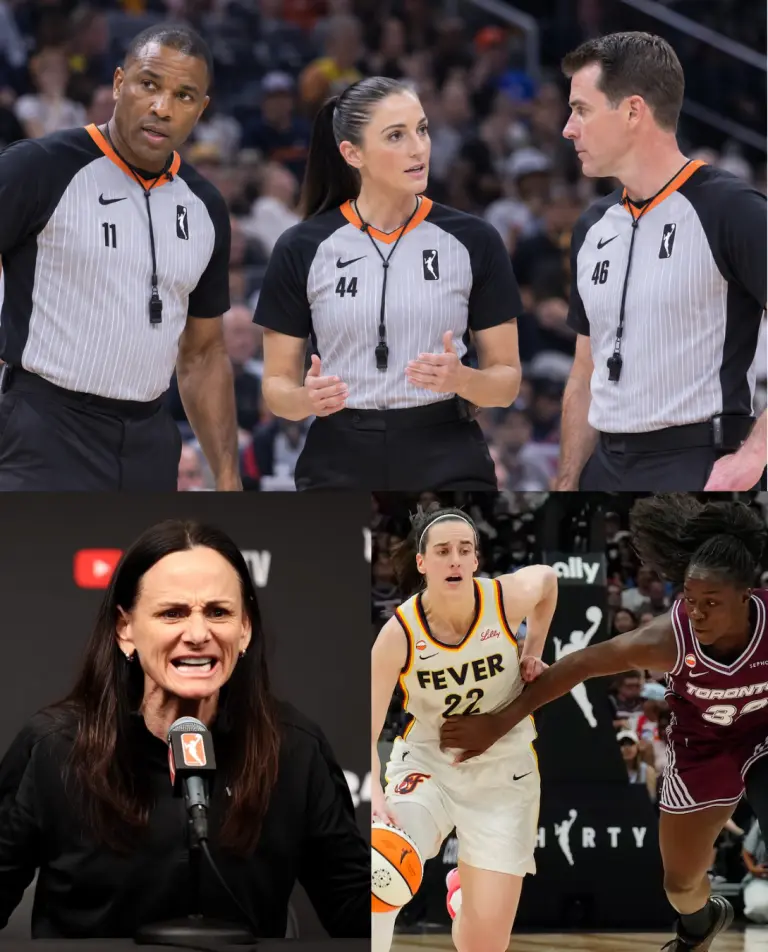
DISCLAIMER: The Indiana Fever’s 103–85 victory over the Toronto Tempo on September 18, 2026 is confirmed. However, this article does not independently verify the circulating claims that Sandy Brondello accused referees of deliberately ignoring Indiana violations, demanded that officials be punished, formally demanded a review of the result, or threatened to escalate the dispute against the WNBA. Those allegations should not be presented as direct Brondello statements without authenticated video, audio, a transcript, an official league/team statement or reliable reporting. The three photographs above are real illustrative images related to Sandy Brondello, Toronto and the Indiana matchup; they do not prove the alleged officiating accusations.