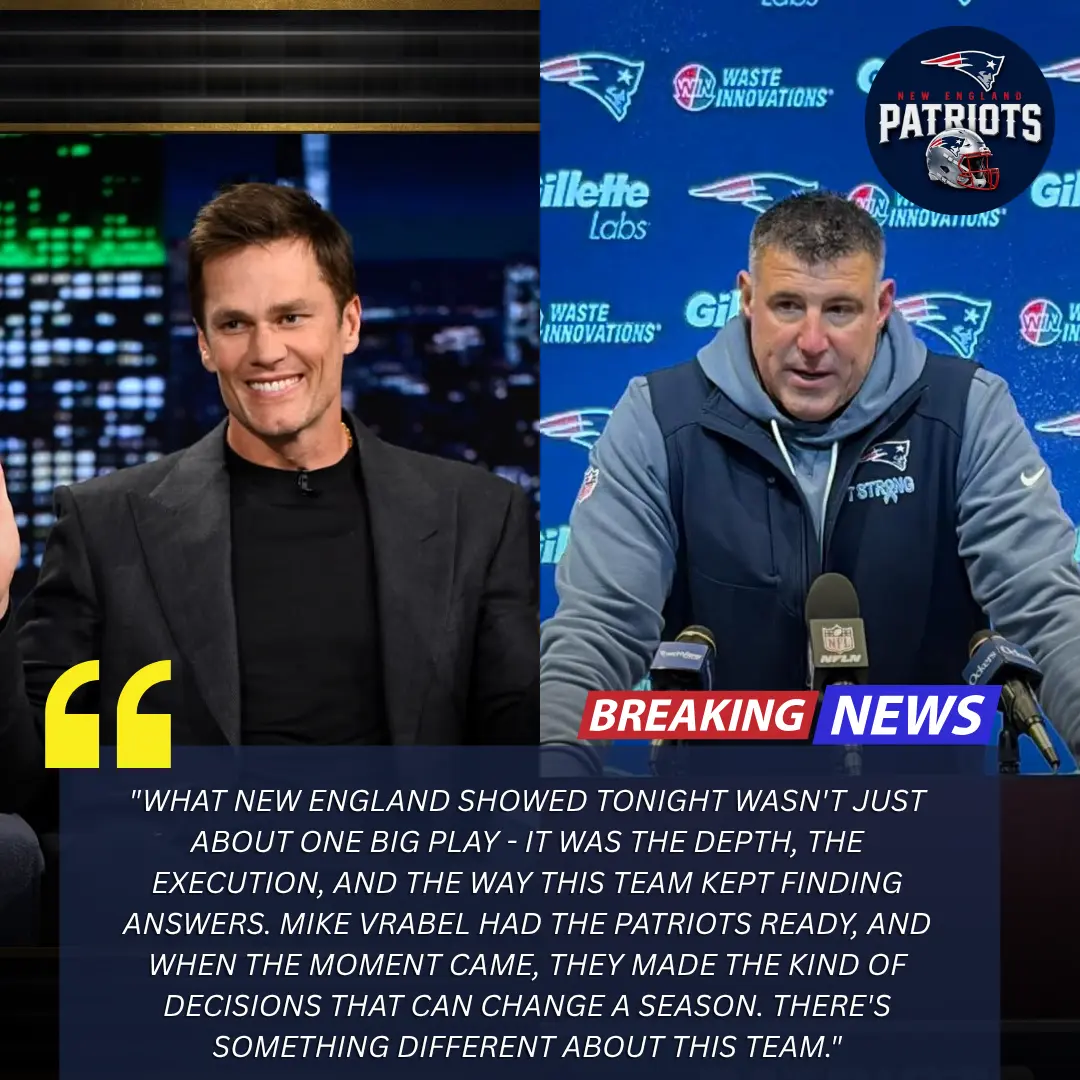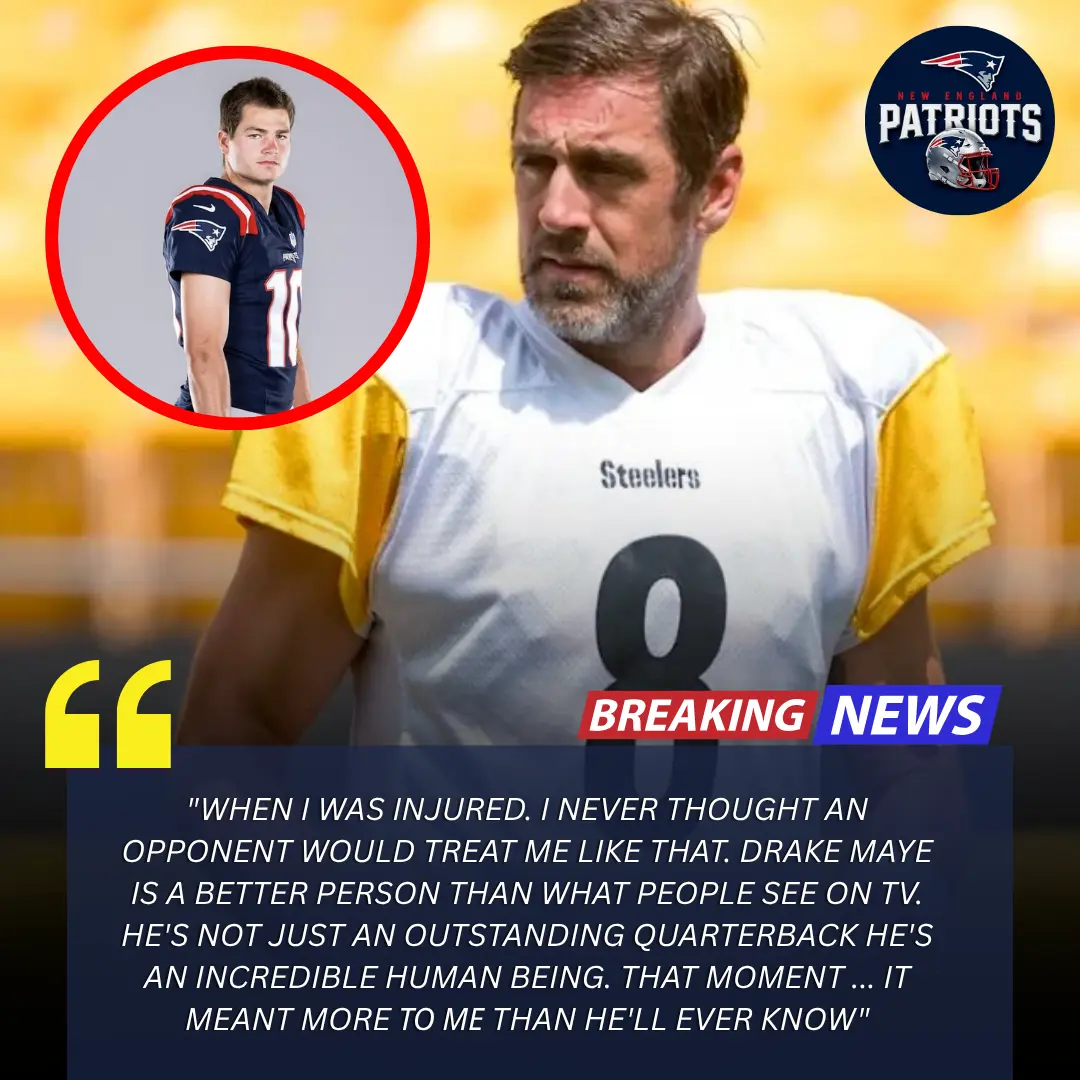
🚨 AFTER THE PATRIOTS’ 20–3 WIN OVER PITTSBURGH, A QUIET DRAKE MAYE–AARON RODGERS MOMENT IS CAPTURING ATTENTION — BUT WHAT WAS REALLY SAID AFTER THE FINAL WHISTLE? 🏈💔
The scoreboard had already delivered the final verdict.
New England Patriots 20. Pittsburgh Steelers 3.
For New England, the September 20, 2026 victory was a reason to celebrate. The Patriots had controlled the afternoon with defense, timely scoring and the kind of disciplined performance head coach Mike Vrabel wants his team to establish.
For Pittsburgh quarterback Aaron Rodgers, however, the ending looked very different.
According to a dramatic narrative circulating online, Rodgers remained near the sideline after the loss, his head lowered as he processed one of the most difficult games of his season.
Then came the part of the story that has captured fans’ attention.
Rather than immediately disappearing into New England’s celebration, Patriots quarterback Drake Maye supposedly walked across the field toward Rodgers.
The younger quarterback allegedly stopped beside the veteran and delivered a quiet message.
No celebration.
No taunting.
No cameras deliberately staged around them.
Just two quarterbacks representing dramatically different generations of the NFL.
The story claims Rodgers appeared visibly stunned by Maye’s words.
It is a compelling scene.
But while the 20–3 result is established, the exact private message supposedly delivered by Maye should not be presented as fact unless authenticated video, audio or direct comments from either quarterback establish what was actually said.


Even without an authenticated transcript, the contrast between the two quarterbacks makes any postgame interaction fascinating.
Rodgers represents an era Maye grew up watching.
A four-time NFL MVP and Super Bowl champion, Rodgers has spent decades operating under enormous expectations. His ability to manipulate defenses, extend plays and deliver throws from unconventional positions helped define quarterback play for an entire generation.
Maye represents something entirely different.
He entered the NFL as the third overall selection in the 2024 draft, carrying the expectations that inevitably accompany a young quarterback in New England.
That pressure is particularly intense because of the franchise’s history.
For twenty seasons, Tom Brady defined the position in Foxborough.
Every Patriots quarterback who follows exists beneath that enormous shadow whether he wants to or not.
Maye cannot become Brady.
Nor should that be the objective.
His challenge is building his own identity while helping New England construct another competitive era.
Against Pittsburgh, that process continued.
Maye did not need to produce an overwhelming statistical performance.
New England’s defense controlled much of the afternoon, and the Patriots found enough offense to create separation.
The young quarterback simply needed to manage the circumstances, make enough plays and help his team leave with the victory.
Rodgers experienced the opposite side of that formula.
New England repeatedly disrupted Pittsburgh’s offensive rhythm.
The Patriots pressured him.
They prevented the Steelers from consistently sustaining drives.
And most importantly, Pittsburgh never reached the end zone.


That is what makes the alleged postgame exchange so emotionally effective.
Football spends three hours turning quarterbacks into opponents.
One wears Patriots colors.
The other wears Steelers colors.
One offense is trying to score.
The opposing quarterback is waiting for his opportunity to answer.
Television coverage reinforces the confrontation.
Maye versus Rodgers.
Young versus old.
New England versus Pittsburgh.
Victory versus defeat.
Then the clock reaches zero.
Suddenly the relationship changes.
The competition is finished.
For a few minutes, quarterbacks can simply become members of an extraordinarily small fraternity.
Only a tiny number of people understand what it feels like to stand behind an NFL offensive line while elite defenders are trying to reach you.
Only NFL quarterbacks understand the preparation required to recognize coverages in seconds.
They understand the criticism.
They understand how one interception can dominate an entire week of conversation.
They understand that victory often produces too much praise and defeat too much blame.
That shared experience explains why postgame quarterback interactions frequently attract attention.
Sometimes they exchange only a handshake.
Sometimes they embrace.
Sometimes the older quarterback offers advice.
Sometimes the younger player expresses respect.
Occasionally, microphones capture a few words.
Often they do not.
When they do not, speculation begins.
That appears to be the most important issue with the Maye-Rodgers narrative.
The story says Maye delivered words Rodgers “likely never expected to hear.”
But what words?
Without an authenticated recording or direct account, filling that blank with a dramatic quotation would transform speculation into something that appears factual.
There is no need to do that.
The image of the two quarterbacks meeting after a physical game already carries meaning without inventing dialogue.


Rodgers’ career also gives the potential interaction another dimension.
When Maye was a child, Rodgers was already an established NFL quarterback.
By the time Maye reached college football, Rodgers had accumulated achievements most players could only imagine.
Now they can stand on opposite sides of the same NFL field.
That is one of professional sports’ recurring cycles.
The stars eventually play against athletes who once watched them from home.
Then the younger generation begins creating its own history.
Respect does not disappear because the competition is fierce.
In many cases, the competition creates the respect.
Maye spent the afternoon trying to help New England defeat Rodgers’ team.
Rodgers was trying to do exactly the same thing to Maye.
Neither quarterback needed to apologize for that.
That is professional football.
But once the final whistle sounded, a handshake or conversation could acknowledge something larger than the result.
Rodgers has experienced almost everything the position can offer.
Championship glory.
MVP seasons.
Playoff heartbreak.
Injuries.
Controversy.
Changing teams.
Unrelenting scrutiny.
Maye is still near the beginning of that journey.
His career will take directions nobody can predict.
There will be brilliant performances.
There will be interceptions.
There will be victories that make Patriots fans dream about championships.
There will almost certainly be difficult afternoons when criticism becomes overwhelming.
That is why interactions between generations can resonate.
The veteran knows what awaits the younger player.
The younger player recognizes what the veteran survived to remain in the league for so long.
But there is another reason the circulating story should be treated carefully.
Sports social media frequently takes an authentic photograph or brief video and adds dialogue nobody actually heard.
A player covers his mouth while speaking.
Another player nods.
A dramatic caption appears:
“Here are the seven words that left him speechless.”
Unless somebody recorded those seven words, the caption is storytelling rather than reporting.
Body language cannot provide a transcript.
A handshake cannot reveal a sentence.
A facial expression cannot prove what someone was thinking.
The same standard applies here.
If Maye and Rodgers spoke after the game, the interaction itself can be meaningful.
But unless their conversation was recorded or one of them later explained it, nobody outside that exchange should pretend to know the exact message.
What is established requires no fictional dialogue.
New England defeated Pittsburgh 20–3.
The Patriots defense delivered a dominant performance.
Maye left the field as the quarterback of the winning team.
Rodgers left after an afternoon in which Pittsburgh managed only three points.
And if the two quarterbacks shared a moment afterward, it represented one of football’s oldest traditions:
Compete relentlessly until the whistle.
Then recognize the person standing across from you.
For Patriots fans, Maye’s development will ultimately be measured by much more than one victory.
They will watch how he responds to adversity.
How he leads.
How he improves.
How he handles success.
And how he carries himself when the cameras are not necessarily focused on him.
That may be why this particular story has connected with people.
It is not really about an imaginary perfect sentence.
It is about sportsmanship.
One quarterback had won.
The other had lost.
Yet for a brief moment, the scoreboard no longer needed to define them.
If authenticated footage eventually reveals what Maye said, fans can judge the exchange with complete context.
Until then, perhaps the strongest version of the story is also the simplest.
Two quarterbacks.
Two generations.
One difficult football game.
And potentially a quiet moment of respect after everything else was over.
Sometimes that is enough.
DISCLAIMER: The New England Patriots’ 20–3 victory over the Pittsburgh Steelers on September 20, 2026 is established. This article discusses a circulating narrative claiming that Drake Maye approached Aaron Rodgers after the game and delivered a private message that left Rodgers visibly surprised. It does not invent or authenticate the exact words allegedly exchanged, nor does it claim to know Rodgers’ private thoughts or emotional reaction. The three photographs above are real illustrative images related to Maye, Rodgers, the Patriots and Steelers and are not presented as proof of the specific alleged conversation. Any exact quotation or detailed account of the exchange should be considered confirmed only if supported by authenticated video/audio, direct comments from Maye or Rodgers, official team material, or reliable reporting.